
Emergency & Storms
Wyoming Blizzard Response: Commercial Snow Drift Removal Protocols
The short answer
How wind turns a modest snowfall into 8-foot drifts, and the heavy-equipment protocols that keep Wyoming commercial lots open and safe during a blizzard.
In most of the country, snow removal is about how many inches fell. In Wyoming, it is about the wind. A storm that drops six inches can leave your parking lot mostly bare in one spot and buried under an eight-foot drift against your building in another. Clearing that is a different job entirely, and it demands different equipment.
At EZ Dayz Landscaping, we contract with commercial properties across Rock Springs and the wider county for exactly this reason. This guide lays out how drifting works, the machinery a real blizzard response requires, and the protocols that keep your lot open, your fire lanes clear, and your business protected from liability.
In this guide
- How 50 MPH Wyoming Winds Turn 6 Inches of Snow into 8-Foot Drifts
- Heavy Machinery Requirements: V-Plows, Skid Steers & Wheel Loaders
- Clearing Commercial Parking Lots, Loading Docks & Fire Lanes Rapidly
- Ice Melting Chemicals That Work in Sub-Zero Temps (Calcium Chloride)
- Preventing Slip-and-Fall Liability on Commercial Walkways
- Contract 24/7 Emergency Blizzard Plowing with EZ Dayz
How 50 MPH Wyoming Winds Turn 6 Inches of Snow into 8-Foot Drifts
Snow in our region rarely stays where it lands. With winds routinely topping 50 MPH, dry powder becomes airborne and travels until something stops it: a building wall, a parked trailer, a fence line, a row of cars. There it piles into drifts many times the depth of the actual snowfall.
This is why an inch total on the forecast can still shut down a loading dock. The problem is not the volume of snow but its concentration. Effective commercial clearing has to anticipate where the wind will stack it and attack those zones, not just push a uniform layer off the pavement.
Wind-packed snow is also far denser and heavier than fresh powder. As it drifts and gets blown around, it compacts, and a set-up drift can be almost as hard as ice. That density is why a straight blade meant for fluffy snow simply glances off or stalls against a drift that a homeowner assumes is soft. Reading the wind and knowing which corners of a property will load up is half the job, and it is knowledge that only comes from clearing the same lots season after season.
Heavy Machinery Requirements: V-Plows, Skid Steers & Wheel Loaders
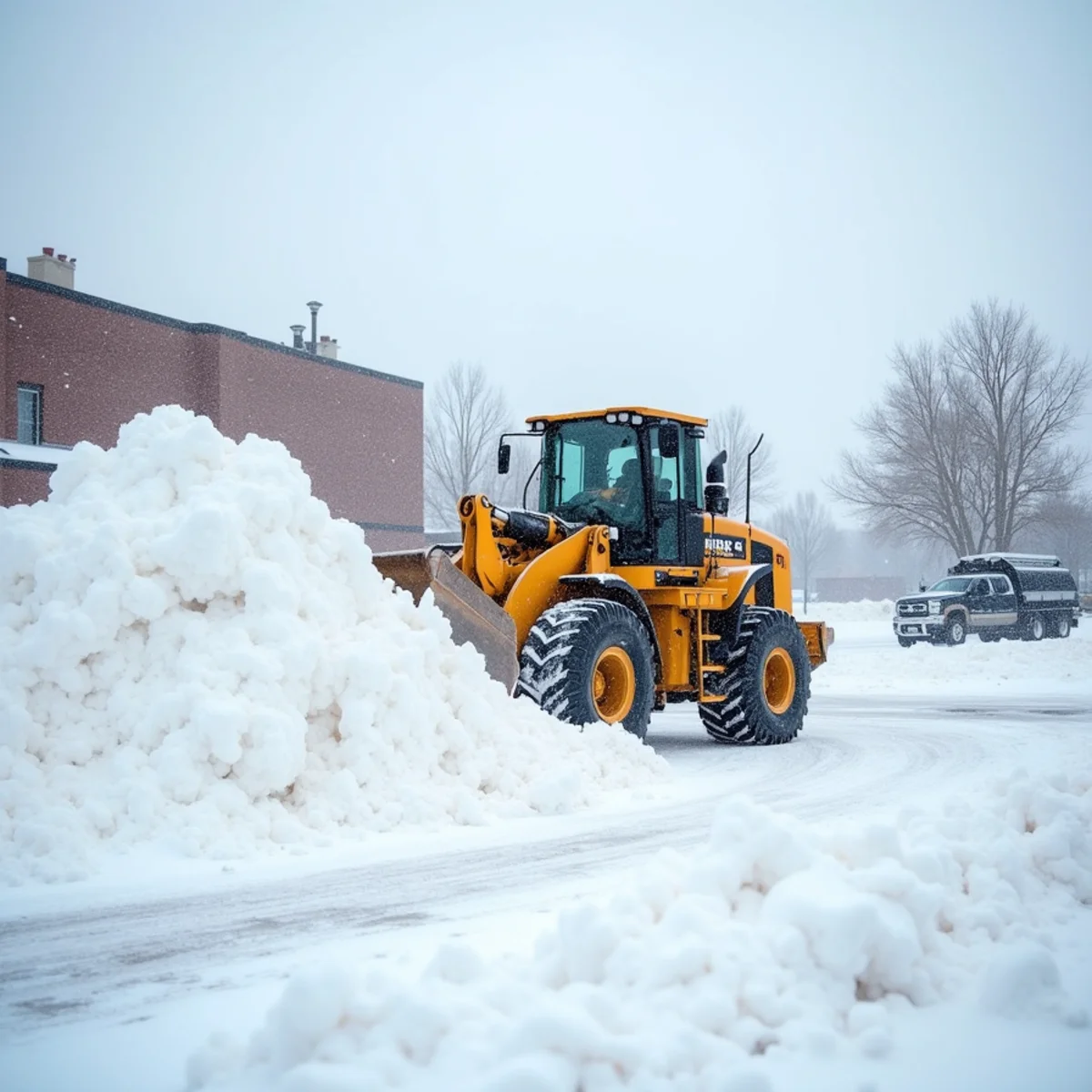
A pickup with a straight blade is fine for a driveway. It is not fine for a compacted eight-foot drift that has set up overnight. Moving that volume of dense, wind-packed snow requires machinery with the weight and hydraulics to break into it and carry it away.
Matching the machine to the task is part of running an efficient operation. A wheel loader that makes short work of a mountainous drift is overkill on a narrow sidewalk, and a skid steer nimble enough for a dock apron cannot relocate the volume a loader can. A properly equipped crew brings the right mix so each part of your property is cleared with the tool suited to it, which is faster, gentler on your pavement, and far more reliable than trying to force one undersized machine to do everything.
- V-plows and box plows to move large volumes and cut through packed drifts
- Skid steers for tight areas, sidewalks, dock aprons, and stacking
- Wheel loaders for the biggest drifts and for relocating piles off the lot
- Backup equipment on standby, because a blizzard is the worst time for a breakdown
Clearing Commercial Parking Lots, Loading Docks & Fire Lanes Rapidly
During an active storm, priority and sequence matter. We clear access first so customers and deliveries can get in, then keep fire lanes and hydrant access open because those are safety and code requirements that do not pause for weather. Loading docks and main travel lanes come next.
Because drifts rebuild while a storm is still blowing, a single pass is rarely enough. Commercial clearing during a blizzard often means repeated cycles through the property, staying ahead of the wind so the lot never fully closes. That cadence is something a contract crew plans for and a one-off caller cannot.
Where we put the snow matters just as much as moving it. Piling it in the wrong corner can block the very access we just cleared, bury a hydrant, or create a melt-and-refreeze hazard across a walkway when the sun comes out. On a well-run commercial job, stacking locations are planned in advance so the piles do not become the next problem, and on larger sites snow sometimes has to be relocated entirely to keep the lot usable through a long storm cycle.
Ice Melting Chemicals That Work in Sub-Zero Temps (Calcium Chloride)
Ordinary rock salt, sodium chloride, stops working as temperatures drop, and in our sub-zero cold it is often useless. That is a problem, because the packed layer left after plowing is where slip-and-fall risk lives. Effective de-icing here means using products rated for extreme cold.
Calcium chloride and similar low-temperature deicers keep working well below where rock salt quits, generating heat as they dissolve and cutting the bond between ice and pavement. Applied correctly and at the right times, they keep walkways and lots trafficable when standard salt would just sit there frozen.
Timing and quantity are their own skill. Applied too early, deicer gets plowed away with the snow; applied too late, ice has already bonded hard to the pavement. The most effective approach often combines mechanical clearing to remove the bulk of the snow with targeted deicer on the compacted layer and high-traffic entries that remain. Used thoughtfully, it also keeps chemical costs and any impact on surrounding landscaping in check, rather than dumping product and hoping.
Preventing Slip-and-Fall Liability on Commercial Walkways
For a business, snow is not just an operational headache, it is a liability. A customer or employee who slips on an un-cleared or icy walkway can turn a storm into a lawsuit. Consistent clearing and de-icing, done on a documented schedule, is your first and best defense.
Contracted service also creates a record. Knowing your property was serviced on a defined protocol, at defined triggers, gives you something to stand on if an incident is ever questioned. Sidewalks, entries, and ADA access routes are not places to cut corners during a Wyoming winter.
There is a customer-experience angle to all this as well. A lot that is consistently clear and safe signals to your customers that your business is open, cared for, and worth their trip on a bad-weather day, while a buried entrance sends them straight to a competitor. Reliable snow service protects not just against liability but against lost business during exactly the stretches when getting people through the door is hardest. In that light, winter clearing is as much about revenue as it is about risk.
Contract 24/7 Emergency Blizzard Plowing with EZ Dayz
Blizzards do not keep business hours, and neither should your snow plan. A seasonal contract means we are watching the forecast, staged with the right equipment, and rolling to your property on defined triggers instead of waiting for a panicked call once the lot is already buried.
Call EZ Dayz Landscaping at (323) 606-0255 to set up a 24/7 commercial snow contract. We will build a clearing and de-icing protocol around your property's access, docks, and fire lanes so you stay open and protected all winter long.
Reading the drift before we plow
On the high plains the snow total on the forecast tells you almost nothing about what is actually sitting in your lot. Fifty-mile-an-hour wind can scour one side of a building down to bare pavement while packing an eight-foot drift against the loading dock and burying the fire lane. We plan the push around where the wind loaded the snow, not around an even blanket, because there is no even blanket out here.
That is why we run V-plows and loaders rather than just a straight blade. A wind-packed drift is dense, closer to a snowbank than fresh powder, and pushing it takes a machine that can knock it apart and carry it rather than shove a wall of it into your only exit.
- We prioritize fire lanes, dock doors, and ADA access first, since those carry the most liability.
- We stack snow downwind of entrances so the next blow does not refill what we just cleared.
- We treat with sub-zero-rated ice melt, because standard rock salt quits working below roughly fifteen degrees.
Why a 24/7 contract beats calling around mid-storm
A slip-and-fall in your parking lot is a liability problem long before it is a snow problem, and the businesses that get burned are usually the ones scrambling to find a plow after the storm has already hit. By then every reputable crew is booked solid clearing their contracted accounts, and you are at the back of the line during the exact hours your customers are arriving.
A seasonal contract puts your property on our route with defined trigger depths and around-the-clock response, so clearing happens overnight before your doors open rather than after the complaints start. To set up 24/7 commercial coverage for the season, call (323) 606-0255 and we will map out your lot's problem drifts.
Frequently Asked Questions
Our 50 MPH winds pick up dry snow and pile it against buildings, fences, and vehicles. A small total snowfall can concentrate into eight-foot drifts in the wrong spots, which is why clearing has to target where wind stacks snow, not just the open pavement.
Often not. Sodium chloride stops melting ice as temperatures drop and is frequently useless in our sub-zero cold. We use calcium chloride and other low-temperature deicers that keep working well below where rock salt quits.
As often as the storm requires. Drifts rebuild while the wind is still blowing, so we run repeated cycles through commercial properties to stay ahead of it and keep access, fire lanes, and docks open rather than making a single pass.
A contract means we are staged with the right equipment and roll on defined triggers, so your lot never fully closes. It also creates a documented service record that helps protect you against slip-and-fall liability.
Written by the crew at EZ Dayz Landscaping
Rock Springs' high-desert landscaping specialists. Need a hand with your yard?